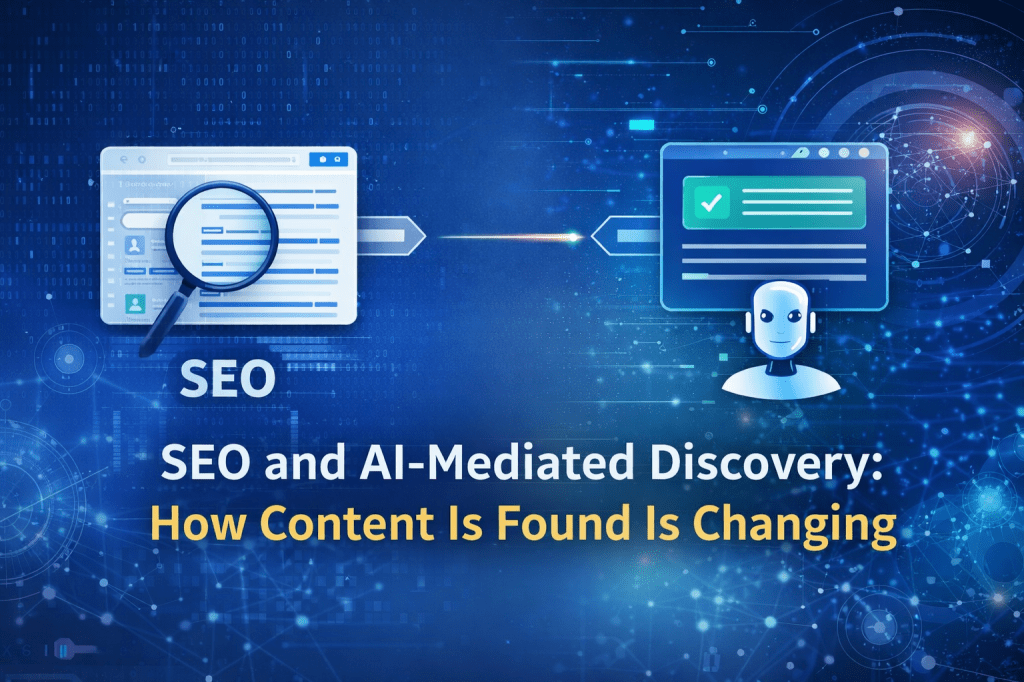
For years, digital visibility has meant one thing: search engine optimization (SEO). Ranking well in search results determined whether content was found, read, and acted upon.
That foundation hasn’t changed—but it’s no longer the complete picture.
As AI-powered systems increasingly generate answers directly for users, we’re seeing a fundamental shift in how content is discovered and consumed. What matters is understanding the pattern: we’re moving from a world where users navigate to content, to one where AI systems interpret and synthesize content on their behalf.
Some practitioners refer to this as “Generative Engine Optimization” (GEO), though this terminology is not yet standardized across the industry.
This post explores both approaches, examining how they differ, why they’re complementary, and what this shift means for content strategy.
SEO: Optimizing for Search Engines
Search Engine Optimization (SEO) focuses on improving how web pages appear in traditional search engine results pages (SERPs). This is well-established territory with decades of refinement.
Core characteristics:
- Protocol layer: HTTP/HTTPS, robots.txt, sitemaps
- Ranking signals: PageRank algorithms, backlink analysis, domain authority, EEAT (Experience, Expertise, Authoritativeness, Trustworthiness)
- Content structure: Keywords, meta tags, schema.org markup, semantic HTML
- Interaction model: User sees ranked results → clicks link → navigates to site
- Measurability: Well-defined (analytics, SERP position, click-through rates)
SEO is fundamentally about discoverability through indexing and ranking. Search engines crawl your content, evaluate its authority and relevance, and surface it when users search for related terms.
AI-Mediated Discovery: A New Pattern
AI-powered systems introduce a different content consumption model. Instead of presenting ranked links, they synthesize answers from multiple sources and present them directly to users.
Whether we formalize this as “GEO” or call it something else, the pattern is distinct enough to warrant attention.
Core characteristics:
- Protocol layer: Same HTTP/HTTPS foundation, but with emerging conventions (llms.txt and others)
- Retrieval mechanism: Semantic search via embeddings, retrieval-augmented generation (RAG), real-time web fetching
- Content requirements: Conversational clarity, contextual completeness, authoritative explanations
- Interaction model: User asks question → AI retrieves and synthesizes → presents answer (citation optional)
- Measurability: Limited and nascent (citation tracking inconsistent, no standard metrics)
This is less about ranking and more about interpretation—how content is understood, decomposed, and reused by language models.
Key Differences
| Aspect | SEO | AI-Mediated Discovery |
| Protocol | robots.txt (standardized) | No standard (conventions emerging) |
| Query type | Keywords, structured phrases | Natural language, multi-turn conversations |
| Ranking signal | Links, authority, keywords | Semantic relevance, recency, clarity |
| Content structure | Hierarchical, keyword-optimized | Conversational, context-rich |
| Output | Ranked list of URLs | Synthesized answers with optional sources |
| User action | Navigate to content | Consume mediated summary |
| Measurability | Mature tooling and metrics | Immature, inconsistent |
These aren’t competing approaches—they address different stages of content retrieval and consumption.
Why Both Matter
From a strategic standpoint, modern content needs to serve both access patterns:
SEO ensures discoverability:
- Content remains findable through traditional search
- Authority signals compound over time
- User intent is captured through keyword targeting
- Direct traffic to your site
AI-mediated discovery enables synthesis:
- Content is reused and cited in generated answers
- Semantic meaning matters more than keyword density
- Context and clarity determine inclusion
- Reach extends beyond direct visits
Ignoring either creates blind spots. A site optimized only for SEO may be indexed but never cited in AI responses. A site optimized only for AI systems may be synthesized but never drive direct traffic.
The “GEO” Term: A Note on Terminology
The term “Generative Engine Optimization” is being used in some circles to describe optimization for AI-mediated discovery. It’s worth noting that this terminology is not yet standardized across the industry.
Unlike SEO, which emerged organically and became universally understood, GEO is still being defined. Different practitioners may mean different things by it, and many avoid the term entirely in favor of more descriptive language like “optimizing for AI citation” or “AI-friendly content design.”
The lack of standard terminology reflects the nascent state of this space. What matters more than the acronym is understanding the underlying shift in how content is consumed.
What Remains Uncertain
It’s important to be realistic about the current state:
Technical maturity:
- No standardized protocol for AI systems to respect site preferences (unlike robots.txt)
- Citation behavior is inconsistent across AI platforms
- Retrieval mechanisms vary widely (pre-indexed vs. real-time vs. hybrid)
Measurability gaps:
- No standard analytics for AI-driven influence
- Attribution is often missing or inaccurate
- Difficult to quantify value when content is synthesized rather than visited
Evolving standards:
- Proposals like llms.txt exist but lack adoption guarantees
- No consensus on how AI systems should attribute sources
- Legal and ethical frameworks still developing
This is an emerging space. Success comes from understanding the patterns, not betting on specific standards.
A Mental Model
When thinking about content optimization, consider three layers:
- SEO optimizes for ranking — Can this content be found and positioned well in search results?
- AI discovery optimizes for interpretation — Can this content be understood and reused accurately?
- Intent alignment optimizes for context — Does this content provide the necessary context to be used appropriately?
Each addresses a different stage of the content lifecycle.
What This Means Practically
Understanding this shift has concrete implications:
For content creators:
- Write clearly and contextually—assume content may be read without surrounding navigation
- Structure content to work both as part of a larger site and as standalone pieces
- Provide explicit context within content, not just in metadata
For content strategists:
- Monitor how content appears in AI-generated responses (manual checking for now)
- Consider both direct traffic metrics and indirect influence
- Balance keyword optimization with semantic clarity
For technical teams:
- Maintain strong SEO fundamentals while exploring AI-friendly patterns
- Consider how content is chunked and accessed at the API level
- Watch emerging standards but don’t over-invest in speculation
Closing Thoughts
Search hasn’t disappeared—it’s fragmenting into multiple discovery patterns.
Traditional SEO remains essential, but it now operates alongside AI-mediated discovery. Both are retrieval mechanisms; they simply operate at different levels of abstraction. One optimizes for being found, the other for being understood and reused.
The shift isn’t complete, and the standards aren’t settled. But the pattern is clear enough to warrant attention. Content that works well in this new landscape is content that serves both human navigation and machine interpretation.
Category: AI & Architecture
 Rajeev Puthezhath